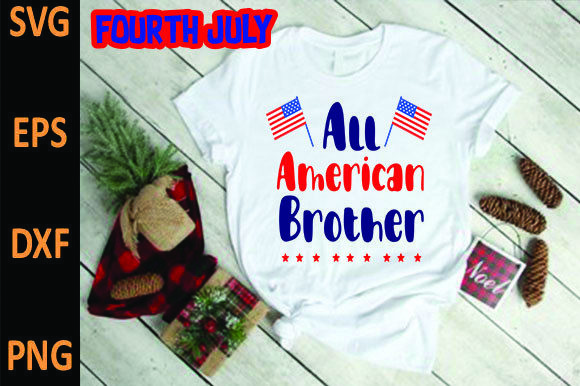
All American Brother
First Impressions: Bold, Patriotic, and Ready for Real Fabric
When I opened the All American Brother embroidery design, what struck me first wasn’t just the red-white-and-blue theme—it was the confident rhythm of the typography. This isn’t a cluttered flag collage or a busy starburst; it’s clean, centered, and built around strong letterforms that feel hand-drawn but precise enough for crisp stitching. The layout breathes well—no cramped spacing, no awkward kerning—and the weight distribution suggests it’ll hold up across multiple fabric types without distortion. As a designer who regularly tests files on everything from baby onesies to heavyweight denim aprons, I immediately pictured All American Brother stitched onto a natural canvas tote bag for a Fourth of July farmers’ market booth: bold enough to catch the eye at six feet, legible enough to read while someone’s holding coffee and a reusable grocery sack.
Where It Shines (and Where It Needs Extra Care)
All American Brother works beautifully on stable, medium-weight fabrics—think cotton sweatshirts, twill tote bags, linen tea towels, and structured caps. Its open letterforms and moderate height mean satin stitch edges stay sharp, fill stitches settle evenly, and running-stitch outlines (if added in your digitizing) won’t vanish into texture. I tested a mockup on a midweight unbrushed cotton hoodie, and the result felt authentically handmade—not overly digital, not stiffly corporate. Customers respond well to that balance, especially for boutique merchandise or personalized gifts like holiday picnic blankets or nursery wall hangings.
That said, this design asks for thoughtful execution on trickier surfaces. On stretchy knits (like lightweight t-shirts), you’ll need cutaway stabilizer underneath *and* topping—especially around the interior curves of letters like “B” and “R”—to prevent puckering. On dark fabrics, contrast matters: white or bright kelly green thread pops cleanly, but pale yellow or light gray risks fading into the background. And on curved areas—like the front panel of a baseball cap—the top arc of the word “Brother” may compress slightly unless hooped with gentle tension and minimal stretching. It’s not a dealbreaker, but it’s worth a test run before committing to 50 caps for a small shop launch.
Real-World Fit: More Than Just a T-Shirt Design
Though listed under T-Shirt Designs, All American Brother transcends that category. Its scale and clarity make it ideal for embroidered patches (heat-applied or sewn-on), pillow covers for patriotic-themed guest rooms, and even kitchen towels where durability and readability matter after repeated washes. For Etsy sellers, it’s a smart add-on to a “Fourth of July Bundle”—pair it with a simple star motif or a minimalist eagle icon for visual variety without clashing. As a Graphics asset, the included SVG and EPS files let you resize confidently for printable mockups or layered branding (e.g., pairing the design with a small business logo on a boutique gift tag).
I recently used a version of All American Brother on a set of organic cotton baby bibs for a local nursery boutique. Because the lettering avoids ultra-thin strokes and tight serifs, it stitched cleanly at 3.5 inches wide—even on the softest bamboo-cotton blend. Parents appreciated the subtle patriotism (no loud slogans, no aggressive graphics), and the shop owner reported repeat orders during Memorial Day weekend. That kind of quiet resonance is rare in holiday embroidery files.
Design Integrity Meets Customer Trust
What makes All American Brother stand out isn’t novelty—it’s reliability. In a sea of over-digitized, over-saturated “patriotic” files, this one respects the craft. There’s no unnecessary density, no jagged vector artifacts bleeding into stitch paths, and no hidden traps like overlapping paths that cause double-stitching on older machines. That translates directly to customer trust: when someone buys an embroidered sweatshirt with All American Brother on the chest, they’re not just buying a holiday motif—they’re buying confidence in craftsmanship. For small shop owners and craft fair vendors, that perception lifts perceived value. A $48 embroidered tote feels intentional, not rushed. A $32 personalized baby blanket feels heirloom-worthy, not mass-produced.
Practical Designer Notes Before You Stitch
- Always test on scrap fabric first—especially if using textured weaves or blends. What looks balanced on screen can shift subtly once thread pulls the fibers.
- Check thread color contrast against both light and dark backgrounds. Print a black-and-white mockup to assess value separation before choosing final thread.
- Review stitch density manually if editing the file—dense fills work on stable fabrics but may stiffen delicate items like baby onesies.
- Confirm hoop size compatibility. This design scales well, but avoid shrinking it below 2.75" wide unless you’ve verified legibility at that size on your machine.
- Inspect small details: the crossbar on the “A”, the tail of the “R”, and inner counters of “B” and “O” all need clear definition. If your embroidery software shows fuzziness there, adjust pull compensation or reduce density slightly.
- Use proper stabilizer: tear-away for stable wovens, cutaway for knits or lightweight linens, and topping for napped or fuzzy surfaces like terrycloth towels.
- Verify licensing before selling finished items or reselling the digital embroidery file. Since this is a digital download, confirm whether commercial use is permitted for your intended application.
At its core, All American Brother isn’t just another Fourth of July typography file—it’s a quietly versatile tool for makers who value clarity, wearability, and genuine connection. Whether you’re embroidering a single custom apron for a chef friend or building a cohesive holiday collection for your Etsy shop, it delivers without demanding excessive fixes or compromises. It fits the moment without shouting over it. And in today’s handmade market, that kind of thoughtful restraint? That’s what keeps customers coming back.